
Talent usage rights and buyouts: what you are paying for
The fee for the person on screen is two fees. One pays for the day of work. The other pays for the right to use what was filmed, and it is the one that comes back a year later when someone wants to run the film again.
That second fee is usage. It is the least understood line on a production quote and one of the easiest to get wrong.
The four things talent usage is made of
Every usage agreement answers four questions.
Media. Where the work appears: online, television, cinema, out-of-home, print, in store.
Term. For how long: three months, a year, two years.
Territory. In which countries.
Exclusivity. Whether the person may appear for a competitor during the term.
On our quotes it is one short line beside each cast member: image usage for a number of months, online, non-exclusive, Vietnam. Four words carry the four answers. Change any one and the fee changes.
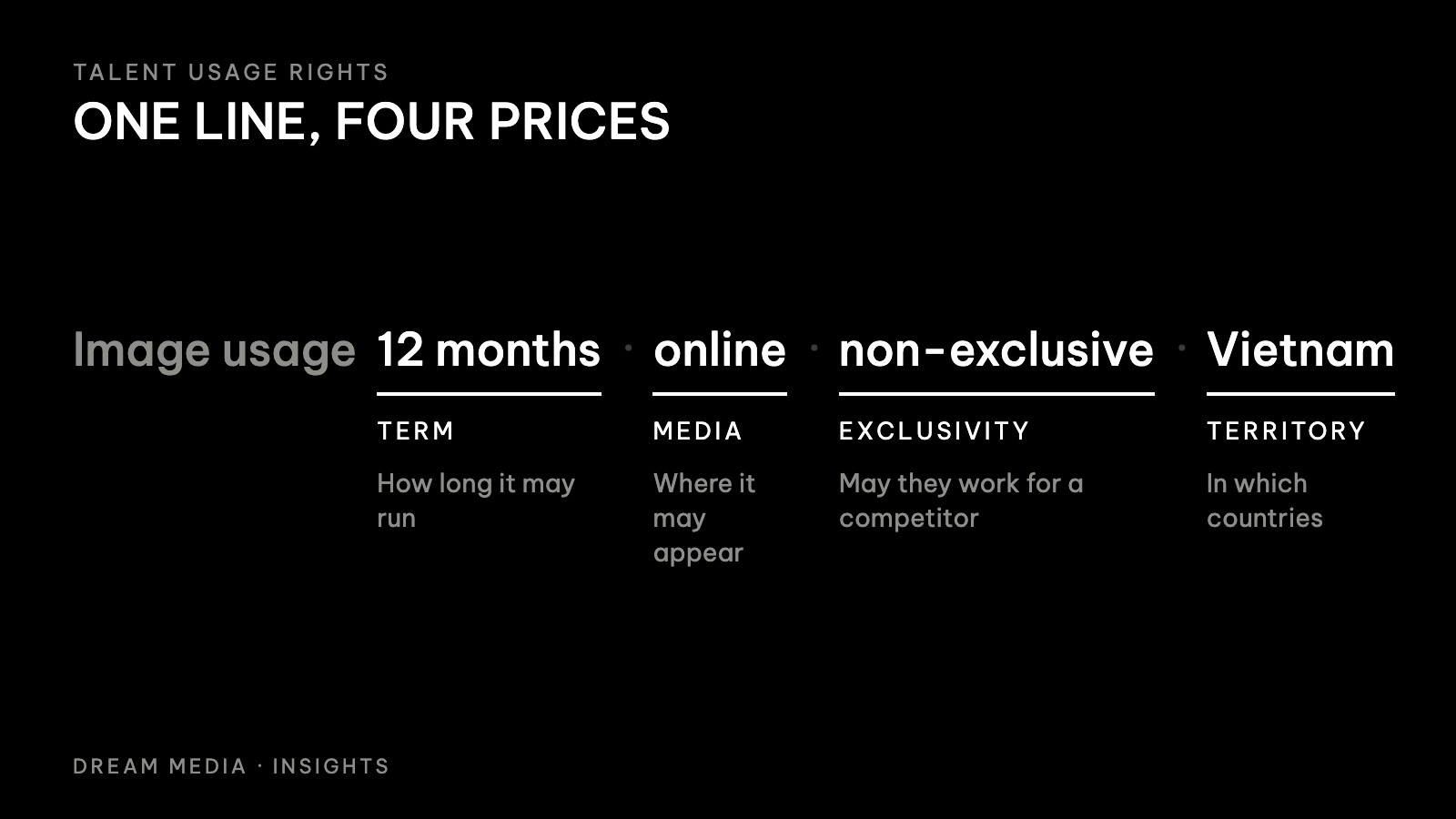
The usage line on a talent quote, word by word. Each word moves the price.
What a buyout is, and what it is not
A buyout is a single payment, made up front, for a defined set of rights. Nothing more is owed while you stay inside them.
It is not ownership of the person's image. The word is often used loosely to mean "everything, everywhere, for ever". Unless the agreement says all media, worldwide and in perpetuity, it does not mean that, and agreements that do say it are priced accordingly.
A buyout is only as wide as the line that describes it.

Background cast at the metro gates for Samsung Wallet: The Metro. Extras are usually paid a flat fee with a release; anyone featured is treated as talent.
Where usage goes wrong
Usage problems almost never start on the shoot. They start months later.
The film travels. A film made for Vietnam is picked up by a regional office. The territory has changed, and nobody has asked the cast.
Organic becomes paid. Posting a film on the brand's own page and putting media money behind it are different uses.
A frame becomes a poster. A still pulled from the film and printed on a billboard is out-of-home and print, not online video.
The term ends and the film stays up. When usage expires, the film has to come off paid placements. Whether posts already on your own channels may stay depends on the contract, so settle it up front. Campaign films still running after their term are a common breach.
A new edit appears. Cutdowns normally run inside the original term rather than starting a new one. Write that into the contract, and check whether extra versions carry a fee of their own.

Real women front the Dove hair bumpers. Anyone featured like this is main talent, with usage of their own.
Famous faces change the sums
With a celebrity or a creator, exclusivity is often the most expensive word, because it keeps them out of a whole category.
Approval rights matter as well: who signs off the edit, the retouching and the stills. And their time on set is short and fixed, so the schedule is built around them.
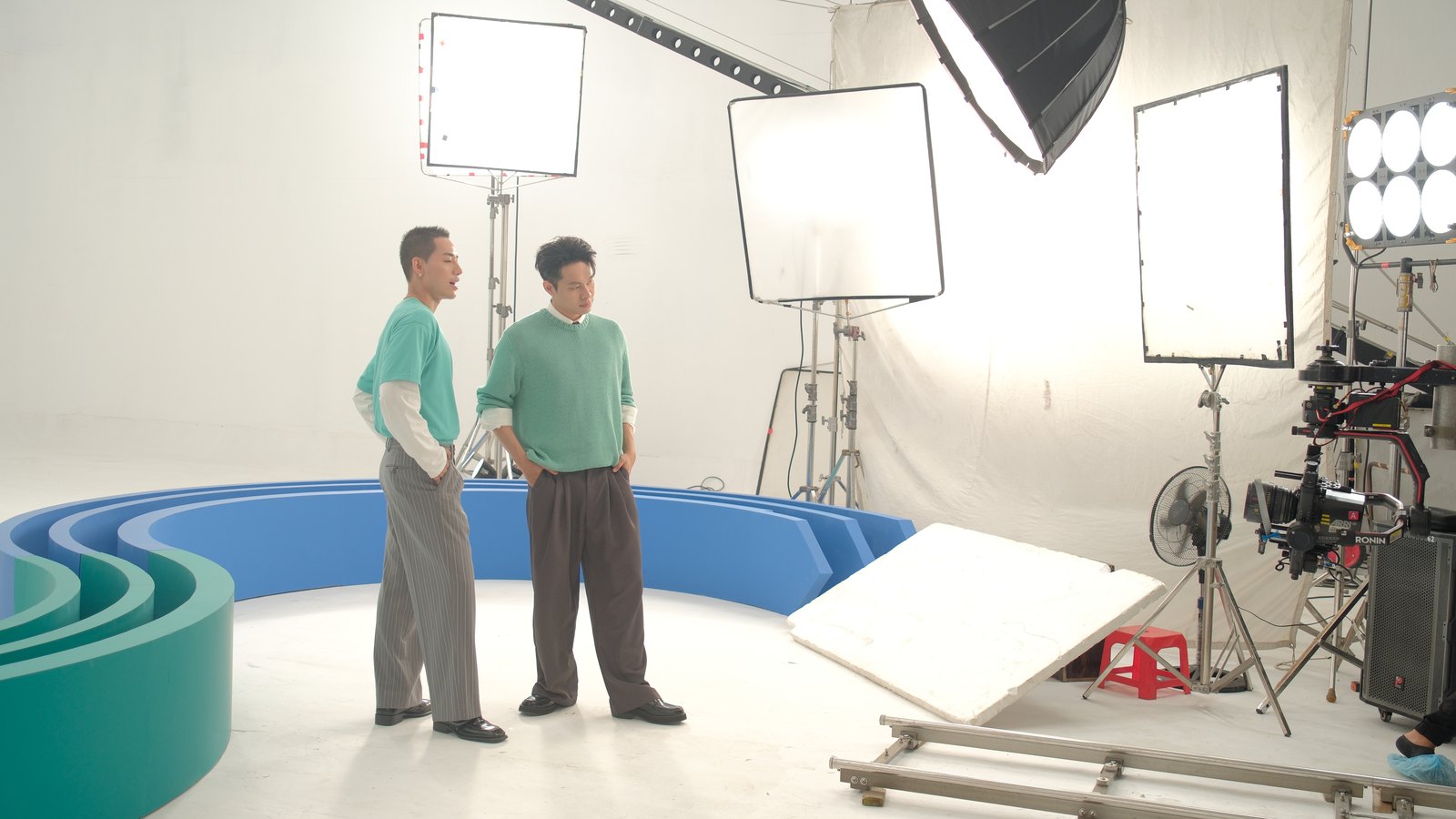
We have shot with artists and public figures across beauty and lifestyle, including CeraVe with HURRYKNG and WEAN and a La Roche-Posay series with Ninh Dương Story, Ánh Viên and the 365 members. On jobs like these the usage agreement should be settled before the call sheet is written.

Checking a take with the cast on our La Roche-Posay series. With well-known talent, who approves the edit and the stills is part of the deal.
Music and voice follow the same logic
Music is licensed on the same four axes.
Library music is inexpensive because the licence is broad and non-exclusive. A known commercial track is priced by media, term and territory, exactly like a face. A composed track can usually be bought for unlimited use, though the composer may keep their performance royalties. That is one reason to commission one for a campaign meant to run for years.
Voice talent is usually paid per version, and by media, term and territory.

A key visual from our Bia 333 photoshoot. Stills have their own usage: print, out-of-home and packaging are all different media.
Settle these before casting
Every channel the film and the stills will run on, including paid social and out-of-home.
The longest the campaign could plausibly run.
Every country it could run in.
Whether you need exclusivity, and against which competitors.
A price for renewal, written into the first contract.
The fifth is the one people skip. At renewal you are negotiating for something you already depend on. Agree the price while you still have a choice.
Put the answers in the production brief, and check them against the talent lines when the quote comes back.

A hall of extras in graduation caps for our Samsung Galaxy A56 film. Decide before casting which of them the camera will pick out, because a featured extra is priced as talent.
Quick answers
What happens when talent usage expires?
The work has to stop running in the media and territory covered, unless usage is renewed. Renewal is a new fee. For the same term it is often the same as the first fee or more, and the talent can say no. Agree a renewal option and its price in the original contract.
Do extras need usage rights?
Background cast are normally paid a flat fee with a release that covers the campaign. Anyone who is identifiable, in the foreground, speaking or reacting to the product is normally treated as featured talent, with usage of their own.
Is talent usage the same as copyright in the film?
No. Copyright in the film is a matter between the client, the agency and the production company. Usage is the permission given by the people who appear in it.
This is a working guide to how usage is priced, not legal advice. The agreement for your campaign should be checked for your own case.
Dream Media develops, directs, shoots and finishes brand films in-house in Ho Chi Minh City.