
Filming permits in Vietnam: what you need, who issues it, how long it takes
Most of what an agency reads about shooting in Vietnam is written to reassure. This is written to be checked.
The rule that decides everything else
A foreign company cannot produce a film in Vietnam on its own account. Article 13 of the Law on Cinema 2022, in force since 1 January 2023, requires foreign organisations and individuals using Vietnamese locations to do it through a Vietnamese film production service provider.
That is not a recommendation about local knowledge. It is the structure the permit is built on: one of the four documents in the application is the service contract with the Vietnamese provider. Without a local company on the paperwork there is no application to file.
So the question was never whether you need a partner here. It is which one, and how early.
Does this apply to a commercial?
Here the honest answer is more useful than a confident one.
The Law on Cinema defines what counts as a film and lists what does not: recordings made to distribute news on broadcast, television or online services; performance programmes; electronic games; and recordings of people, events, situations or reality programmes.
Advertising is not named in that list. Not as included, not as excluded.
What follows from that in practice is not a reading of the statute. It is what the location owner, the district, and the client's own legal team will accept on the day. A brand film shot inside a rented studio and a commercial shot across a public square in District 1 are the same thing to the Law on Cinema and completely different things to the people who control the space.
This is the single most common reason a foreign producer's schedule slips: the national permit was assumed to be the whole job, or assumed to be irrelevant. It is usually neither.
The national permit: what is actually in the envelope
Issued by the Ministry of Culture, Sports and Tourism. Four documents:
A written request on the Minister's prescribed form
A summary script, and a detailed script of the scenes to be shot in Vietnam, in Vietnamese
The filming service contract with the Vietnamese provider
A written undertaking not to breach Article 9, which lists prohibited content
Statutory time: 20 days from receipt of a complete, valid dossier, under the Law. The procedure published in April 2026 (Decision 895/QĐ-BVHTTDL, under Government Resolution 66.16/2026/NQ-CP) shortens this to 12 working days at the Cinema Department.
Two words in that sentence carry the risk. Complete and valid. The clock does not start when you send the envelope; it starts when nothing is missing. A script translated loosely, or a service contract signed by an entity that is not a registered film production establishment, resets you to day zero without anyone telling you the clock was never running.
One relief compared to the old law: since 2022 you submit the detailed script only for the scenes shot in Vietnam, not the whole film. For a commercial with a two-day Vietnam leg inside an international campaign, that is the difference between a translation job and a translation project.
Location permission is a different thing entirely
The Ministry permit says you may film in Vietnam. It does not say you may film here.
Private and rented property, studios. The owner's agreement is the permission. No state licence.
Streets, squares, parks. District-level authority, and usually the ward too.
Heritage sites, museums, religious buildings. The managing body, on their own terms and their own timescale, often with a fee and an escort.
Airports, ports, metro, military-adjacent areas. A separate operator approval, and the slowest of the lot.
These run in parallel with the national permit, not after it. Sequencing them one at a time is how a four-week lead time becomes ten.

A rented stage is the simple case: the owner's agreement is the permission, and nothing goes to a district office. The moment a setup crosses onto a street, that stops being true.
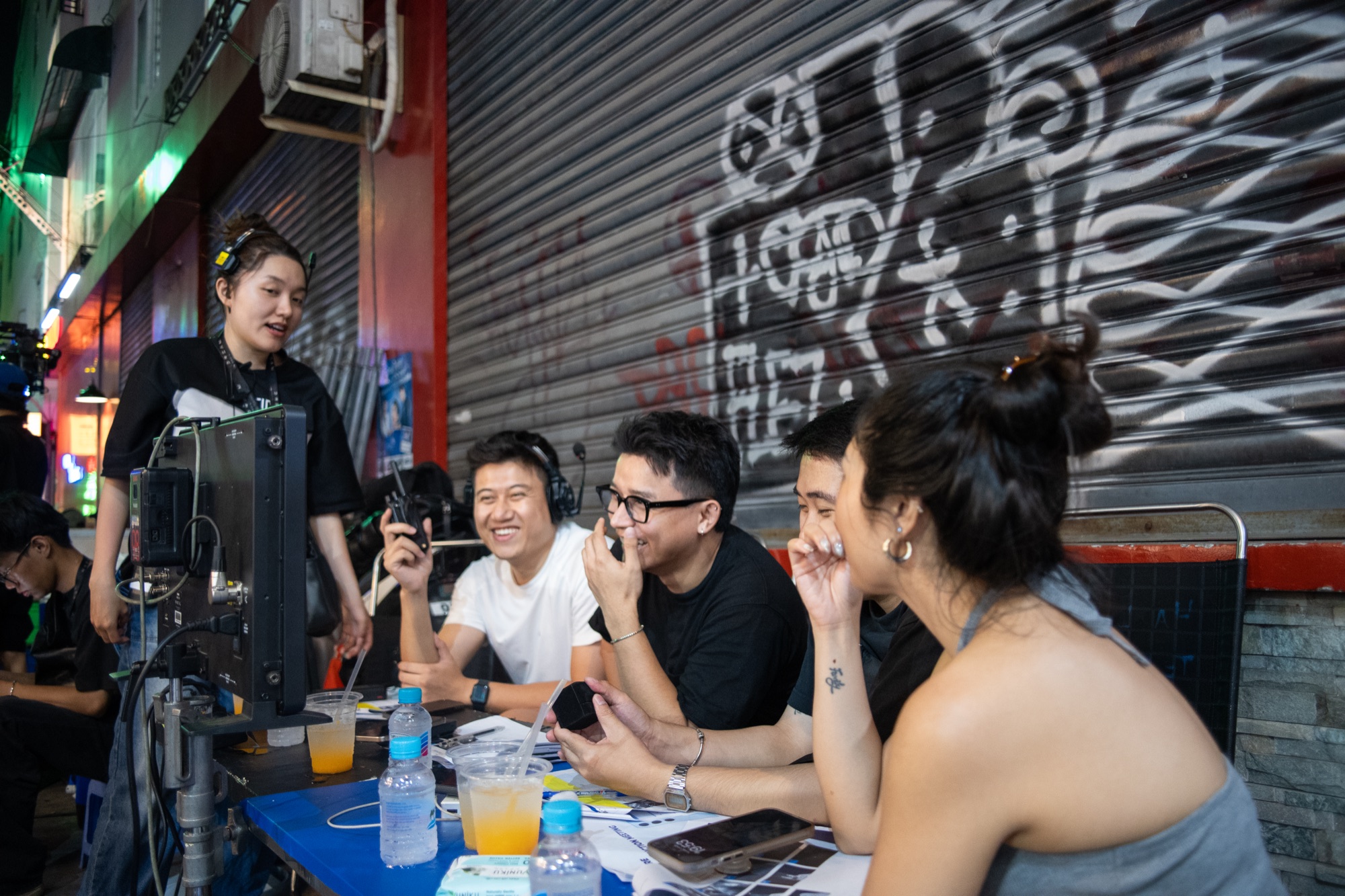
Video village on the pavement during a night exterior for Samsung Galaxy S24: Nightography. Once the setup is on a street, the district and usually the ward have a say.
Drones are a separate regime with a separate ministry
Nothing above covers a drone. Since 5 November 2025, aerial work sits under Decree 288/2025/ND-CP, which replaced Decree 36/2008/ND-CP. The flight permit comes from the Ministry of National Defence, not the culture ministry.
What that application wants is unlike anything else on the shoot:
the exact coordinates, latitude and longitude, of every point you intend to fly
the dates, the altitude ceiling, and the purpose
for a foreign operator, a guarantee from a Vietnamese organisation or individual
permission is mission-specific: it covers those coordinates on those dates and nothing else
The decree sets the lead time: file at least seven days before the flight, or at least twelve where the flight affects published airways or airfields and a notice to airmen is needed. The decision is due within five working days of a complete file. Plan on three weeks.
Since 1 July 2026 the drone itself must be registered in Vietnam, or temporarily registered, and the pilot must hold a Vietnamese flight licence or an international certificate recognised by the Ministry of National Defence. A foreign pilot also needs a Vietnamese guarantor.
The operational consequence matters more than the paperwork: a drone permit cannot absorb a location change. Move the setup two hundred metres on the day because the light turned, and you are flying outside the approval. Scout the aerials first, lock the coordinates before you lock anything else, and build the ground plan around them rather than the reverse.
This is also the area of Vietnamese regulation that has moved most in recent years, so confirm it per shoot rather than per year.
Crew and kit
Two things that are not permits but stop a shoot just as effectively.
Visas. A foreign crew member coming to work is not a tourist, whatever the entry stamp says. Settle the category and the invitation paperwork in prep, not in the week before the flight.
Equipment. Cameras, lenses and grip crossing the border as temporary imports need a customs route agreed in advance, and the route has to be chosen before anything is crated. For most commercials the cheaper answer is to bring the people and hire the kit here. That is a budget question rather than a legal one, but it is the paperwork that usually decides it.
What this means for a schedule
Read the list in one go and the shape of the problem is clear: four approvals, four different authorities, four clocks that only run in parallel if somebody starts them in parallel.
That is the actual argument for a line producer here, and it is not the one usually made. It is not that a local company is cheaper. It is that the national permit, the district permission, the site's own agreement and the defence ministry's coordinates cannot be sequenced by someone in another time zone reading a translated statute, and the cost of learning that is measured in shoot days, which is the most expensive unit on the budget.
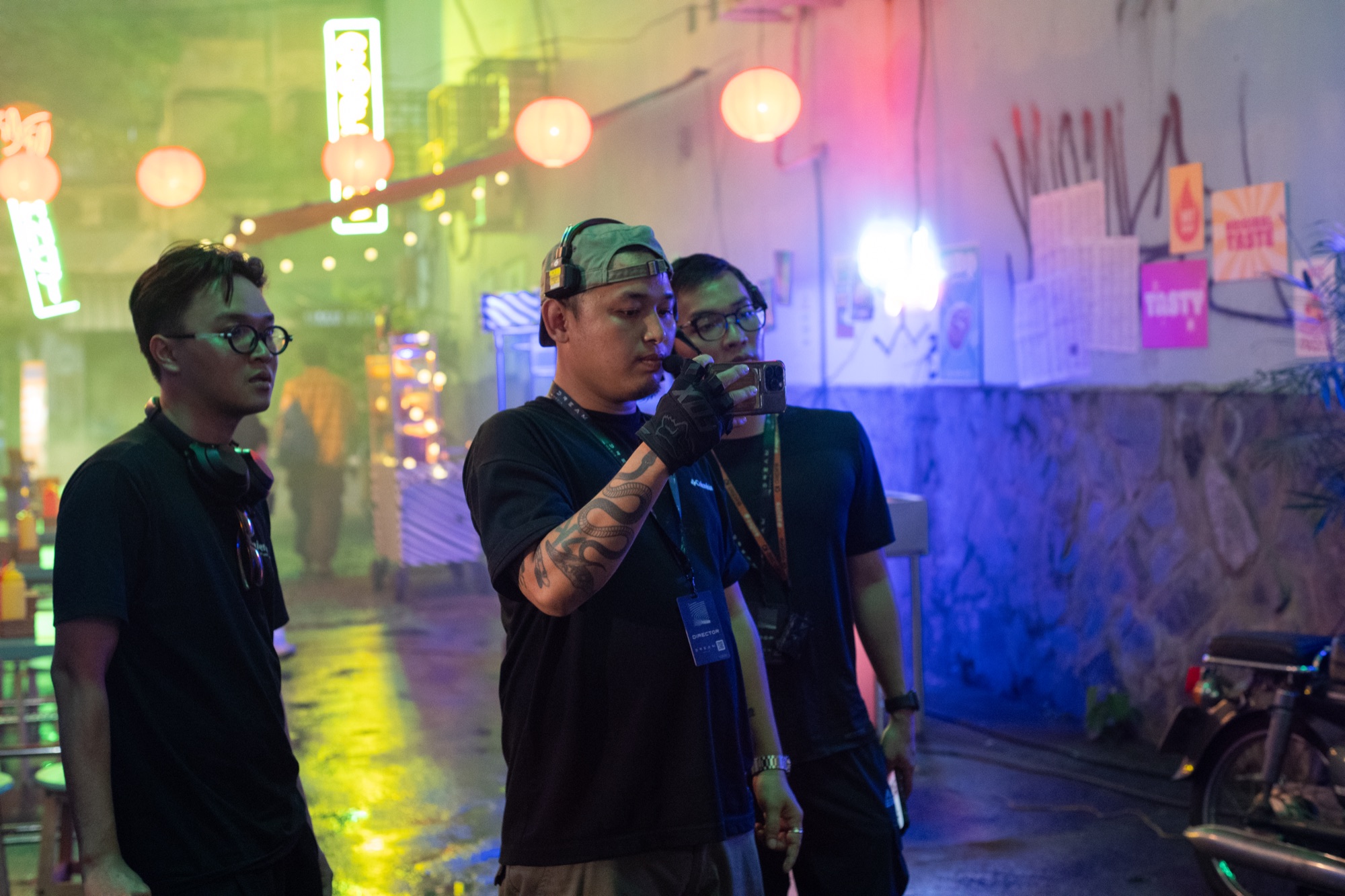
A night exterior in an alley for Samsung Galaxy S24: Nightography. The approvals behind a night like this have to be started together, or the date slips.
This is a working summary of public regulation as of October 2026, not legal advice. The rules move, the drone regime in particular. Anything here that decides a schedule should be confirmed for your specific shoot.
Dream Media provides line production in Vietnam for agencies and production houses shooting here. See what that covers.